 Get in touch with our supplier
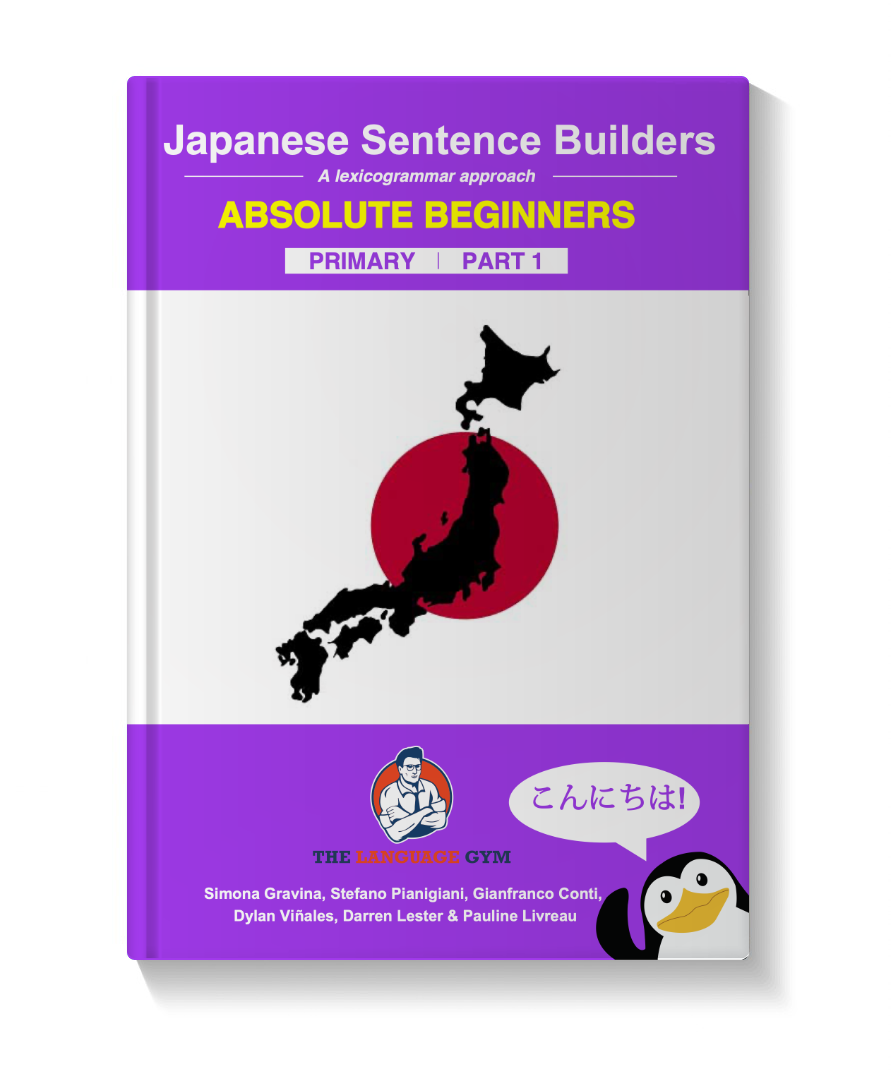
Japanese Primary Sentence Builders - Book 1 is a workbook aimed at beginner students, co-authored by four modern languages educators with over 80 years of extensive classroom experience between the four, both in the UK and internationally.
Most Japanese presented in this book is in hiragana (or katakana where necessary) with romaji presented as ruby text. The book does not use kanji at all. The book’s focus is on associating hiragana with sounds in order to promote fluency of reading. Activities which focus on reading comprehension use romaji, to allow learners to focus on the meaning of the vocabulary and being able to use the language quickly and spontaneously.
This book contains 10 units which concern themselves with a specific communicative function, such as ‘I can say my name and age’, ‘I can talk about the weather’, ‘I can say what is in my town’. You can find a note of each communicative function in the Table of Contents. Each unit includes:
- a sentence builder modelling the target constructions, introduced by questions to guide communication;
- a set of Listening-As-Modelling activities to train decoding skills, sound awareness, speech-segmentation, lexical-retrieval and parsing skills;
- a set of reading tasks focusing on both the meaning and structural levels of the text;
- a set of translation tasks aimed at consolidation through retrieval practice;
- a set of writing tasks targeting essential writing micro-skills such as spelling, functional and positional processing, editing and communication of meaning;
- a set of writing tasks targeting correct hiragana formation.
Each sentence builder at the beginning of a unit contains one or more constructions which have been selected with real-life communication in mind. Each unit is built around that construction but not solely on it. Based on the principle that each E.P.I instructional sequence must move from modelling to production in a seamless and organic way, each unit expands on the material in each sentence builder by embedding it in texts and graded tasks which contain both familiar and unfamiliar (but comprehensible and learnable) vocabulary and structures. Through lots of careful recycling and thorough and extensive processing of the input, by the end of each unit the student has many opportunities to encounter and process the new vocabulary and patterns with material from the previous units.
Alongside the units you will find: No Snakes No Ladders tasks created to practise speaking skills with an engaging and fun board game that can be photocopied and played in groups of 3 students.
Based on the E.P.I. principle that learners learn best from comprehensible and highly patterned input flooded with the target linguistic features, the authors have carefully designed each and every text and activity to enable the student to process and produce each item many times over. Alongside the units you will find: No Snakes No Ladders tasks created to practise speaking skills with an engaging and fun board game that can be photocopied and played in groups of 3 students.
Please note that the SentenceBuilders.com website is an ideal supplement to this booklet.
TABLE OF CONTENTS
|
Unit |
Topic |
Page |
|
1 わたしのなまえ |
I can say my name & age |
1 |
|
2 かきかた |
Alphabet and phonics |
17 |
|
3 おげんきですか |
I can greet and say how I am |
30 |
|
4 わたしのたんじょうび |
I can say when my birthday is |
44 |
|
5 ぶんぼうぐ を ください |
I can ask for items of stationery |
64 |
|
6a わたしのけいたいばんごう |
I can say what my phone number is |
86 |
|
6b じょすうし |
I can count items in Japanese |
91 |
|
7 どこにすんでいますか |
I can talk about where I live |
115 |
|
8 てんきはどうですか |
I can talk about the weather |
136 |
|
9 わたし のまち |
I can talk about my town |
154 |
|
10 わたし の まち に |
I can say what is in my town |
175 |